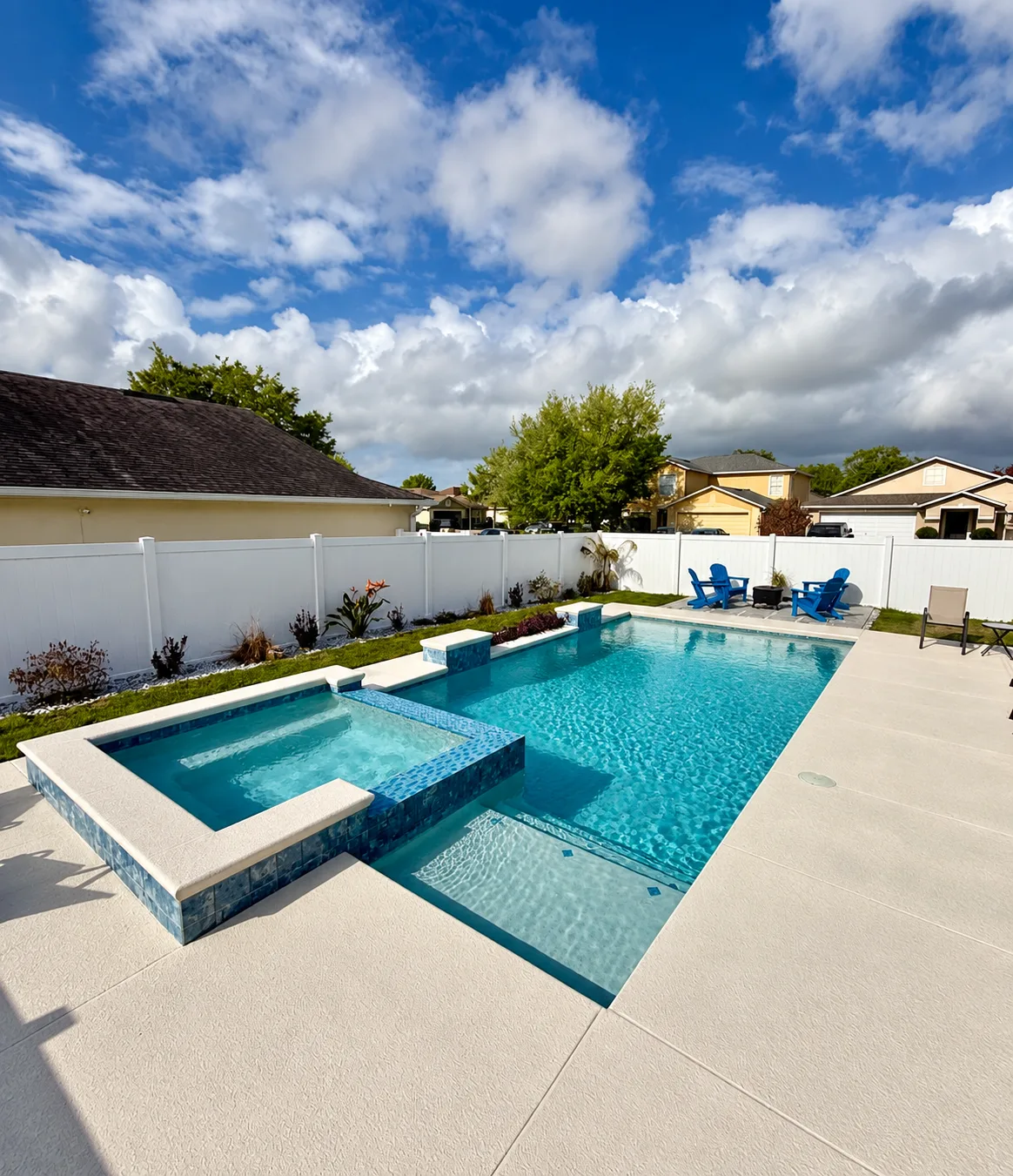
Neither design is universally better. A raised spa typically creates a stronger visual focal point and can incorporate a spillover, while a pool-level spa creates a cleaner, more integrated look with the surrounding pool.
The better choice depends on appearance, accessibility, backyard layout, views, water features, construction complexity, and budget. For Orlando homeowners planning a custom concrete pool with an attached spa, the spa elevation should be decided as part of the complete pool design rather than treated as a separate feature later.
What Is the Difference Between a Raised Spa and a Pool-Level Spa?
A raised spa sits above the pool’s waterline or surrounding pool elevation, while a pool-level spa is designed closer to the same visual elevation as the pool.
Both can be integrated into a custom inground pool, but the difference in elevation can affect appearance, access, sightlines, spillway design, deck transitions, structural details, and plumbing.
What Is a Raised Spa?
A raised spa is an attached spa constructed at a higher elevation than the main pool.
It may include a spillway or spillover into the pool, but a raised spa does not have to include one. The added elevation may also be used simply to make the spa more visually prominent within the pool layout.
What Is a Pool-Level Spa?
A pool-level spa is an attached spa designed close to the same visual elevation as the main pool.
This creates a more integrated appearance and can help preserve lower sightlines across the pool and backyard.
Raised Spa vs. Pool-Level Spa Comparison
The main differences involve elevation, appearance, access, spillover potential, views, and how the spa affects the rest of the pool design.
| Design Factor | Raised Spa | Pool-Level Spa |
| Appearance | More visually prominent | More integrated with the pool |
| Accessibility | May require added elevation changes or steps | Often provides a more direct deck approach |
| Spillover Potential | Well suited to visible spillways | Water-feature options may be more subtle |
| Views | Can interrupt some sightlines depending on placement | Usually preserves lower, more open sightlines |
| Construction Complexity | May require more elevation, structural, and transition planning | Still requires careful shell, plumbing, and deck coordination |
| Cost Considerations | Elevation, exposed walls, finishes, and spillways can add cost | Not automatically less expensive |
| Best-Fit Homeowner | Wants more architectural emphasis or a visible water feature | Wants a cleaner, more integrated pool-and-spa layout |
The table is only a starting point. Two spas at the same elevation can still have very different costs and design requirements based on size, finishes, plumbing, shell geometry, equipment, and site conditions.
Is a Raised Spa or Pool-Level Spa Better for Your Backyard?
Choose a raised spa if you want the spa to stand out more within the pool design. Consider a pool-level spa if preserving sightlines and creating a cleaner visual relationship between the pool and spa are higher priorities.
A raised spa may make more sense when you want:
- A more visually prominent spa
- A noticeable spillway
- More elevation within the pool layout
- Greater separation between the pool and spa
A pool-level spa may make more sense when you want:
- A lower visual profile
- More open backyard sightlines
- A more integrated pool-and-spa appearance
- Fewer elevation changes around the surrounding deck
The better option depends on how those priorities fit the actual property.
Why Do Homeowners Choose a Raised Spa?
Homeowners often choose a raised spa because the added elevation gives the spa more visual importance within the overall pool layout.
It can also create more opportunity for exposed tile, stone, coping, or other finish details on the spa wall.
How Does Elevation Affect the Appearance?
A raised spa introduces a vertical element into a mostly horizontal pool environment.
That can help define the spa as a separate architectural feature, especially when it is visible from the house, patio, or another primary viewing area.
The elevation should still feel proportional to the pool. Raising the spa without considering its location, scale, and surrounding deck can make the layout feel disconnected.
What Are the Advantages of a Pool-Level Spa?
A pool-level spa creates a more unified visual relationship between the pool and spa.
Because the spa stays closer to the same elevation as the pool, it may work well where homeowners want clean lines, lower visual barriers, and uninterrupted views across the backyard.
The spa can still be visually defined through:
- Shape
- Coping
- Interior finish
- Tile
- Seating configuration
- Placement within the pool layout
A pool-level spa does not have to look plain. The design can still be highly customized without relying on elevation to create visual interest.
Which Spa Design Creates a Better Spillover or Water-Feature Effect?
A raised spa generally provides more opportunity for a noticeable spillover because the additional elevation gives the water a visible drop into the pool.
This can make the spillway part of the pool’s overall visual and hydraulic design.
The spillway width, elevation, plumbing, pump capacity, and operating water levels need to work together so the spa can circulate properly and the spillover performs as intended.
A raised spa does not automatically need a spillover. If moving water is not an important part of the backyard design, the spa can still be elevated without using a prominent water feature.
How Does Spa Elevation Affect Concrete Pool Construction?
Spa elevation affects more than the finished appearance. It can influence excavation, steel reinforcement, shell geometry, plumbing runs, spillway construction, coping elevations, deck transitions, and structural loading.
Because the spa is formed as part of the concrete pool structure, its height, steps, seating, plumbing penetrations, and spillway dimensions should be resolved before steel placement and shell construction.
A pool-level spa still requires careful coordination. Shell geometry, coping relationships, plumbing layout, deck elevations, and access points all need to work with the surrounding pool structure.
The goal is to make the spa elevation work with the pool structurally, hydraulically, and visually.
How Are the Pool and Spa Plumbing Systems Integrated?
An attached spa has to be coordinated with the pool’s circulation, heating, valves, controls, suction plumbing, return plumbing, and equipment layout.
Elevation alone does not determine whether the spa will operate well. The hydraulic design has to support how water moves between the pool, spa, spillway, and equipment under different operating conditions.
This becomes especially important when the spa is heated separately, shares equipment with the pool, or includes a spillover.
The pool and spa should be designed as one coordinated system rather than as two independent features.
Is a Raised Spa More Expensive Than a Pool-Level Spa?
A raised spa can cost more when the elevation adds structural work, exposed walls, finish materials, spillway construction, or more complex transitions.
However, a pool-level spa is not automatically less expensive.
What Actually Affects the Price Difference?
The final cost can depend on:
- Spa size and shape
- Amount of elevation
- Structural design
- Exposed spa walls
- Coping and finish materials
- Spillway width and design
- Plumbing layout
- Equipment requirements
- Deck integration
- Site access
- Overall pool geometry
A straightforward raised spa may cost less than a large pool-level spa with complex seating, finishes, and plumbing.
The better question is whether the added elevation contributes enough design or functional value to justify the additional construction requirements.
Is a Raised Spa Worth the Extra Cost?
A raised spa may be worth the additional cost when the elevation supports a clear design goal, such as a stronger architectural feature, a visible spillway, or a specific relationship with the house and pool.
It may provide less value if the spa is raised only because elevated spas are perceived as more upscale.
The elevation should have a reason within the overall pool design.
Which Spa Design Is Easier to Enter and Exit?
A pool-level spa can provide a more direct approach from the surrounding pool deck because there is less elevation change to account for.
Actual ease of entry still depends on the deck elevation, spa coping height, step configuration, handholds, and surrounding circulation.
A raised spa can still be comfortable to use when the transition is planned correctly.
Homeowners should consider:
- Who will use the spa most often
- Step locations
- Coping height
- Handholds where appropriate
- Walking paths around the spa
- Nearby deck space
- How the spa entry affects circulation around the pool
Accessibility should be considered early in the design process rather than after the spa elevation has already been selected.
How Does Your Backyard Layout Affect the Best Spa Elevation?
Your backyard layout can determine whether a raised spa improves the design or creates unnecessary problems with views, circulation, or deck space.
The spa should be evaluated from the house, patio, pool deck, and other important viewing or walking areas.
How Do Views Affect Spa Placement?
A raised spa can block or interrupt sightlines if it is placed directly between the house and another important backyard feature.
That does not mean raised spas should be avoided when views matter. It means the spa’s height and location should be evaluated together.
Important sightlines may include views toward:
- The length of the pool
- Landscaping
- A lake or pond
- Outdoor seating
- The far side of the yard
- Areas where children may be swimming
In some layouts, moving the spa or lowering its elevation may preserve those views without changing the rest of the pool design.
How Does Deck Space Affect the Spa Design?
Spa elevation does not automatically determine how much space the spa occupies, but it can affect how surrounding deck space is used.
Raised spas may need more attention around steps, transitions, coping, and approach areas. Pool-level spas may fit more naturally into some compact layouts because there are fewer changes in elevation.
The complete circulation path around the pool matters more than the spa footprint alone.
Can a Raised Spa Block Views From the House or Pool Deck?
Yes. A raised spa can interrupt views when its elevation and location fall directly within an important sightline.
That is why the spa should be studied from the primary viewing areas before the elevation is finalized.
A pool-level spa generally has less visual impact because it stays closer to the main pool elevation.
For some Orlando backyards, that may be more important than making the spa a focal feature.
Which Design Works Better With a Modern Pool?
Both raised and pool-level spas can work well with modern custom pool designs.
A pool-level spa may support long horizontal lines and a lower visual profile. A raised spa may create contrast by introducing a stronger geometric form into the pool layout.
A raised spa can work well with:
- Geometric shapes
- Exposed tile
- Stone or finished walls
- Spillways
- Layered elevations
A pool-level spa can work well with:
- Clean horizontal lines
- Minimal transitions
- Open sightlines
- Geometric pool layouts
- Lower-profile backyard designs
The design style should come from the complete pool composition rather than the spa elevation alone.
How Does Spa Placement Affect the Pool and Spa Combination?
Spa placement affects access, views, swimming space, deck circulation, and how connected the spa feels to the pool.
For that reason, placement and elevation should be decided together.
An attached spa may be located:
- Near the house for easier access
- At one end of the pool
- Along the side of the pool
- Near outdoor seating
- Within a geometric transition in the pool shape
A raised spa near the house may become visually prominent from indoor living areas. A pool-level spa in the same position may preserve a lower sightline across the backyard.
There is no single correct location for every property.
How Should a Pool and Spa Design Work With an Orlando Backyard?
An Orlando pool and spa layout should be coordinated with the house, deck, patio, landscaping, drainage, screen enclosure when applicable, equipment location, and available buildable area.
The spa should not be positioned independently from those features.
The design may need to account for:
- Paths between the house and pool
- Pool deck width
- Outdoor seating areas
- Screen-enclosure layout
- Landscaping
- Drainage
- Equipment placement
- Backyard views
- Setbacks and usable construction space
In one backyard, a raised spa may help organize the pool layout. In another, a pool-level spa may make the space feel more open and easier to navigate.
Should Spa Seating Affect Your Design Choice?
Spa seating should influence the layout, but it does not automatically determine whether the spa should be raised or pool-level.
The better question is how people will use the spa and where they will face while seated.
Consider:
- How many people may use the spa together
- Where users enter and exit
- Whether seating should face the pool, house, or landscaping
- How the seating affects conversation
- How the spa relates to nearby deck areas
A spa that looks good from the patio but creates awkward seating or entry conditions may not be the strongest overall design.
What Should You Decide Before Choosing Your Pool and Spa Layout?
Decide how important appearance, accessibility, spillover effects, views, circulation, and budget are before selecting the spa elevation.
A useful design discussion starts with homeowner priorities rather than assuming one type of attached spa is automatically better.
Ask yourself:
- Should the spa stand out or blend into the pool?
- Do I want a noticeable spillover?
- Which backyard views should remain open?
- How easy should spa entry and exit be?
- Where will people walk around the spa?
- Where will the spa be viewed most often?
- Do I prefer more elevation or a flatter waterline?
- How much of the budget should go toward spa elevation and finishes?
- How should the spa relate to nearby seating areas?
- Does the layout work with the complete backyard?
These questions usually make the decision much easier.
Should You Choose a Raised Spa or a Pool-Level Spa?
Choose a raised spa when you want more elevation, a stronger architectural presence, or a more noticeable spillover. Choose a pool-level spa when preserving sightlines, simplifying deck transitions, and creating a more integrated pool-and-spa relationship are higher priorities.
The right choice should also work structurally and hydraulically. Artesian Pools can evaluate an Orlando property’s spa elevation, concrete shell design, plumbing, spillway requirements, deck transitions, access, views, and overall pool layout before the final pool and spa configuration is selected.