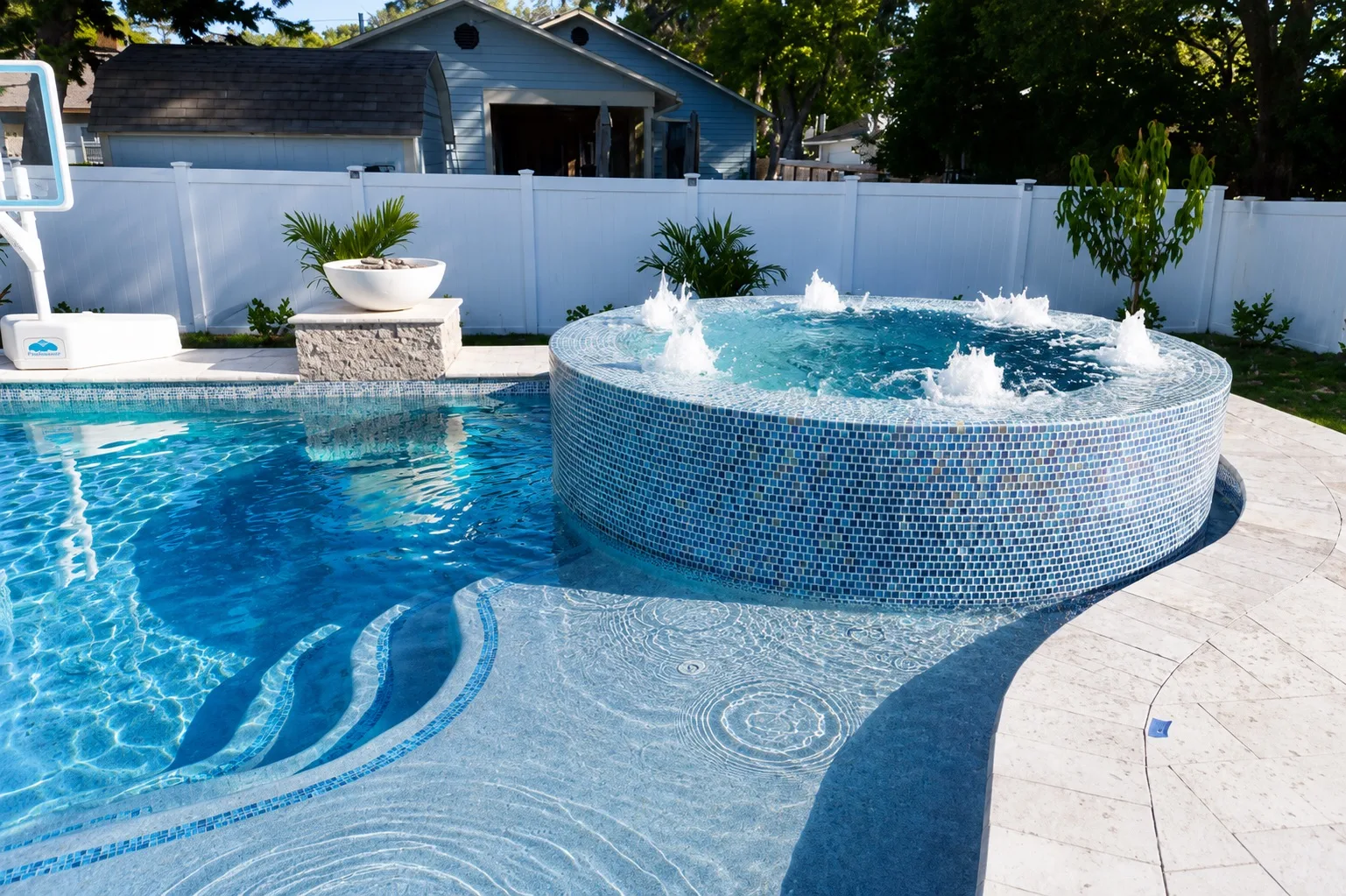
Before discussing specific price ranges, custom pool-and-spa projects in Orlando can vary widely in cost based on pool dimensions, spa configuration, site conditions, access, engineering, equipment, decking, finishes, and permitting requirements. Treat published ranges only as early planning references until the property and design are evaluated.
As a result, understanding what drives that investment helps homeowners make confident decisions before breaking ground.
How Much Does a Pool and Spa Combination Cost in Orlando?
Custom pool-and-spa pricing varies substantially based on pool dimensions, spa configuration, site access, engineering, finishes, equipment, decking, and jurisdictional requirements. Any published range should be treated as preliminary until the property and design have been evaluated.
Typical Starting Investment for Custom Projects
For planning purposes, attached spa combinations in the Orlando market tend to fall across three general tiers. However, these are illustrative planning ranges only; actual proposals vary by scope, site, jurisdiction, and market conditions.
| Package Level | Description | Illustrative Planning Range |
| Standard | Mid-size pool, attached spa, basic decking, standard finish | $80,000 – $100,000 |
| Upgraded | Larger pool, elevated spa, travertine decking, LED lighting, automation | $100,000 – $130,000 |
| Luxury | Freeform design, resort-style spa, premium finish, water and fire features | $130,000 – $200,000+ |
These figures are illustrative planning references. They assume typical site access and conditions and may exclude major drainage work, retaining structures, utility upgrades, extensive enclosure work, demolition, and landscaping. A site-specific design consultation and itemized proposal are required before a reliable construction budget can be established.
Why Does Adding a Spa Increase the Cost of a Pool?
In reality, a spa is not a simple add-on — it changes the engineering, the plumbing layout, the equipment sizing, and the construction sequence of the entire project. However, many homeowners expect a spa to add a modest fixed cost; the actual increase depends on the spa configuration, elevation, finish selections, and site conditions.
Specifically, adding a spa means:
- Additional reinforced structural work: An attached spa adds reinforced forming, additional excavation, more steel and concrete, and — in raised configurations — more complex elevation and spillway construction
- Dedicated plumbing circuits: Jet systems, blowers, and circulation lines must be designed and installed alongside the pool's plumbing
- Equipment and plumbing designed for the full scope: The equipment and plumbing must be designed for the required pool circulation, spa jet flow, heating performance, and operating modes
- Additional electrical work: Spa jets and heating require extra circuits, GFCI protection, and often a sub-panel
- Additional plan review and inspections: A pool-and-spa project may require additional plan review and inspection checkpoints for structural, plumbing, electrical, gas, barrier, and equipment work, depending on the jurisdiction and project scope
In Central Florida, high water tables and expansive soils can add further excavation costs. Dewatering needs are property-specific and should be assessed before construction begins — they are not reliably captured by published planning ranges.
Pool Only vs. Pool with Attached Spa: Cost Comparison
The figures below are illustrative planning references only. Actual costs vary by pool dimensions, spa configuration, site conditions, finish selections, equipment specifications, and jurisdictional requirements. Permit fees in Orange, Seminole, and surrounding counties are project-specific and should be confirmed directly with the applicable building department.
| Cost Category | Pool Only | Pool + Attached Spa |
| Shell Construction | $20,000 – $45,000 | $30,000 – $65,000 |
| Plumbing | $8,000 – $15,000 | $14,000 – $25,000 |
| Electrical | $4,000 – $8,000 | $8,000 – $15,000 |
| Equipment (Pump, Heater, Controls) | $5,000 – $12,000 | $10,000 – $20,000 |
| Decking and Coping | $8,000 – $20,000 | $10,000 – $25,000 |
| Permits and Inspections | Varies by jurisdiction | Varies by jurisdiction |
| Illustrative Planning Total | $50,000 – $100,000 | $80,000 – $150,000+ |
What Factors Have the Biggest Impact on Pool and Spa Pricing?
Design decisions made early in the planning process have a greater effect on the final price than most homeowners expect. Five factors consistently move the number the most.
Pool Size and Shape
Larger pools require more excavation, concrete, steel, and finishing material. Freeform designs cost more than geometric pools because custom formwork and irregular tile or coping cuts significantly increase labor time.
Spa Size, Elevation, and Finishes
A raised or elevated spa — one that sits above the pool deck and spills water down into the pool — costs more than an in-ground spa set at deck level. Elevation adds structural work, additional plumbing, and more finish material. Premium interior finishes, such as full-tile interiors or pebble surfaces, also increase spa costs regardless of size.
Orlando-Specific Site Conditions
Additionally, Central Florida's high water table means many builds require groundwater management during excavation, and expansive clay soils in some Orlando-area lots require additional footer work to prevent shell movement over time. Consequently, groundwater management, engineering, permit fees, inspections, and HOA review can add both cost and time, but the amount depends on the property, jurisdiction, project scope, and approval process. A thorough pre-construction site assessment will surface both conditions before they become surprises.
Material Selection
Likewise, concrete pools provide substantial flexibility for integrated spas, custom elevations, spillways, depth transitions, and finish selections, but these design options also affect engineering, labor, and material costs. The finish — pebble, quartz aggregate, or full tile — also significantly affects the final number.
Permitting and HOA Requirements
Finally, permitting in Orange, Seminole, and surrounding Central Florida counties adds both time and cost. Permit fees, plan review, required inspections, and HOA design approval all vary by jurisdiction and project scope — the applicable building department or permitting portal is the most reliable source for current requirements and fees. Plans and documentation must be reviewed through the applicable jurisdiction before permits and inspections can be finalized.
Is an Attached Spa More Affordable Than a Separate Spa?
When comparing two custom-built concrete options, an attached spa may cost less than constructing a separate spa vessel because some equipment, plumbing infrastructure, decking, and controls can be coordinated with the pool. A manufactured portable spa is a different product category and should not be compared on the same basis.
By comparison, an attached spa can be structurally integrated with the pool and share equipment, controls, plumbing infrastructure, and the surrounding deck — thereby reducing the cost of duplicating those systems.
In contrast, a freestanding spa placed away from the pool requires:
- A fully independent shell and foundation
- A separate equipment pad with its own pump, heater, and controls
- Dedicated plumbing and electrical runs from the home
- Additional decking, coping, and finishing material around the spa itself
When comparing two custom-built concrete options, an attached spa can reduce duplicated structural, equipment, plumbing, and decking work, although the final difference depends on the design and operating configuration.
What Features Can Increase the Cost of a Pool and Spa Combination?
Every upgrade adds to the base price. The most common additions that move the number are:
Spillover Spas, Water Features, Lighting, and Automation
- Elevated spillover spa: Cost varies based on elevation height, structural support, spillway configuration, plumbing, and finish selection
- Water features (spillways, deck jets, bubblers): Cost varies based on feature type, count, plumbing requirements, and structural integration
- Fire features (fire bowls, fire-and-water combinations): Cost varies based on feature size, fuel source, plumbing, and gas line requirements
- LED color lighting: Cost varies based on fixture count, placement, and control integration
- Automation systems (app-controlled lighting, heating, jets): Cost varies based on the number of controlled functions, equipment compatibility, panel capacity, and integration requirements
- Tanning ledges or sun shelves: Cost varies based on size, depth, finish, and structural design
- Travertine or paver decking (vs. standard concrete): Cost varies based on material selection, square footage, pattern complexity, and site preparation
- Screen enclosure: May contribute to the required pool-barrier system when designed, permitted, and constructed to meet the applicable code requirements; cost varies based on enclosure size, structural design, and permitting requirements
Features tend to compound — homeowners who add a water feature often add lighting to complement it, and automation becomes more valuable as the feature count grows.
How Do Equipment and Heating Requirements Affect the Total Investment?
Equipment is one of the most significant cost drivers in a pool-and-spa project — and one of the most commonly underestimated. A pool can run on a modest pump and basic controls alone. A pool-and-spa combination requires plumbing and equipment designed for pool filtration, spa jet flow, rapid heating, feature operation, and the intended shared or separate operating modes.
Key equipment cost factors include:
- Heater sizing: Spa heating capacity should be calculated around spa volume, desired heat-up time, fuel source, hydraulic design, and the manufacturer's specifications. Gas heaters are often selected where rapid heat-up is a priority, while heat pumps generally operate more gradually
- Variable-speed and multi-speed pumps: Energy-code requirements may call for multi-speed or variable-speed capability for qualifying residential filtration pumps; spa jet pumps, feature pumps, and other equipment are selected separately based on their function
- Automation and controls: Managing pool and spa temperatures, jets, lighting, and features separately requires a dedicated automation system; pricing varies based on the number of controlled functions, equipment compatibility, panel capacity, and integration requirements
- Blower systems: Spa air injection (the "bubbles") requires a dedicated blower separate from the jet pump
Choosing undersized equipment to reduce upfront cost typically results in poor spa performance and higher long-term service costs. Equipment decisions made at the design stage are difficult to reverse once construction is complete.
Is a Pool and Spa Combination Worth the Extra Cost in Orlando?
A pool-and-spa combination may be worthwhile when the household expects to use both features regularly, and the additional construction cost fits the long-term ownership plan. The decision should be based primarily on use, comfort, design goals, and budget rather than an assumed resale return.
Florida's climate does extend the practical use window for a spa compared to northern markets — but how much value that adds depends entirely on how the household intends to use the space. Homeowners who entertain regularly, use an outdoor living area year-round, or have a specific therapeutic or lifestyle need for a spa tend to find the investment justified. Those who are uncertain about regular use may want to weigh whether the added construction cost aligns with those goals before committing.
What Is a Realistic Budget for a Custom Pool and Spa Project?
A realistic budget accounts for the base construction cost, site-specific conditions, feature selections, and permitting — not just the shell. Homeowners who budget only for the pool structure frequently encounter surprises once excavation, equipment, and decking are added.
Example Budgets for Standard, Upgraded, and Luxury Designs
The three planning tiers introduced earlier in this article — Standard, Upgraded, and Luxury — reflect meaningful differences in shell size, spa configuration, finish quality, feature count, and equipment specification. Each tier represents a different set of structural and design commitments, not simply a finish upgrade.
The right starting point depends on pool dimensions, spa type, site conditions, and the complete scope of construction — not the tier label alone. However, a site-specific design consultation and itemized proposal are needed before any of these ranges can be applied to a specific property.
How Can Homeowners Prioritize Features to Stay Within Budget?
The most effective approach is to separate structural decisions from aesthetic upgrades — and to protect the structural budget first. Elements like shell size, equipment quality, and plumbing design are fixed once construction begins. Finishes, features, and landscaping have more flexibility.
A practical prioritization framework:
- Lock in the right shell size first: Undersizing the pool to save money and regretting it later is common; upsizing after construction is not possible
- Invest in the equipment package: Undersized or underpowered equipment is the most common source of long-term dissatisfaction
- Choose durable finishes over decorative ones: Pebble and quartz finishes may provide greater durability than basic plaster, although service life depends on installation quality, water conditions, use, and care
- Stage cosmetic upgrades: Fire features, additional water features, and expanded landscaping can often be added in a second phase — structural work cannot
- Build in a contingency: Include a project contingency that reflects the site conditions and the level of uncertainty identified during planning
Homeowners who protect the structural decisions and build flexibility into the aesthetic choices tend to end the project more satisfied than those who do the opposite.
Plan Your Pool and Spa Budget Around the Property and the Full Construction Scope
A realistic pool-and-spa budget is based on more than the size of the pool or the addition of a spa. Site access, excavation conditions, structural design, plumbing, equipment capacity, heating, decking, finishes, permitting, and optional features all influence the final proposal. Evaluating these elements together helps homeowners understand which costs are necessary for construction and which are driven by design preferences.
Because every Orlando property has different access, drainage, soil, utility, and approval conditions, published price ranges can only serve as an early planning reference. A site-specific design and itemized proposal are needed before a reliable construction budget can be established.f
In our experience, two similarly sized pool-and-spa designs can be priced very differently when one property has open equipment access and stable excavation conditions, while another requires dewatering, additional footer work, or a longer plumbing run. The spa finish itself is rarely the largest cost variable — equipment capacity, plumbing distance, site access, elevation changes, and structural integration usually have a greater effect on the final proposal. Homeowners most often underestimate the cost of equipment, plumbing complexity, decking, and site access — not the visible spa finish itself. Knowing where the real cost drivers are makes it easier to prioritize confidently and avoid surprises mid-project.
At Artesian Pools, pool-and-spa projects are evaluated based on the property, intended use, structural requirements, and the full scope of construction. This approach helps homeowners clearly compare options and make informed decisions before finalizing design selections and construction commitments.